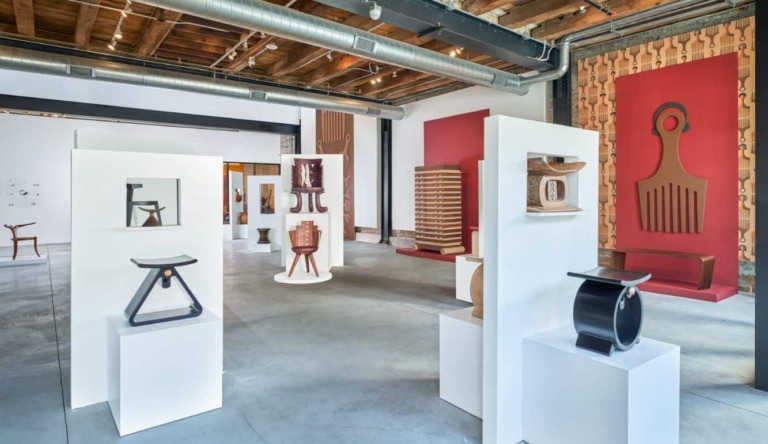
In the world of contemporary furniture design, few voices resonate as powerfully as that of Jomo Tariku a creator whose work bridges continents, cultures, and centuries of tradition. Born in Kenya, raised in Ethiopia, and educated in the United States, his multicultural background is more than a footnote, it is the foundation of a design philosophy that honors African heritage while pushing the boundaries of modern form. Known for iconic pieces like the Nyala Chair and the Masaai Shield Totem Chair, his work seamlessly blends historical symbolism with minimalist sophistication, bringing underrepresented narratives to the forefront of global design. In this conversation, we explore the roots of his creativity, the challenges of being a cultural ambassador through craft, and what it means to design with intention, identity, and legacy in mind.
I was born in Kenya and grew up in Ethiopia. My father was a civil servant who was part of the diplomatic community in Nairobi and traveled a decent amount representing the Ethiopian government. During his career he always brought back souvenirs and artwork from wherever he traveled to, mostly in Africa. Within the diplomatic community they also exchanged unique and cultural gifts that represented their nation so our home was filled with diverse artifacts. These objects were things I would sketch out of boredom during summer breaks - never thinking my future career would be adjacent to the things I was drawing. Furniture.
Once I moved to the US to go to college I discovered Industrial Design where your final year is dedicated to researching and solving a design problem. Using this as a basis I tried to come up with a contemporary design language that would help me design new furniture pieces that still represent my culture but are modern.
It involves mostly doing a deep dive into various books related to Africa and not necessarily on furniture only. I have a collection of books that cover patterns, architecture, metalsmithing to combs, hair weave and afro design. From this research I take design ques and sketch them just to document them then I revisit these ideas that picked my mind to see if I can come up with new designs.
As an Industrial Designer who incorporates artistic flares into my work the goal is always finding ways to marry these two approaches. In a way I am a minimalist as I unpack a concept and take away elements from a design without making it lose its essence and its connection back to Africa.
Your Nyala Chair and other iconic designs have gained international recognition. Which of your works are you most proud of, and why?
Definitely the Nyala Chair is up there for me but I do love all the chairs I have created as I come up with so many ideas but only few make it to the prototype stage and then production - either in limited series for collectors or limited quantity. This also includes my experimental/conceptual ones like the Masaai Shield Totem Chair.
I always give credit to the artisans coming from the different regions I study as part of my design research. The unfortunate part is it is hard to find a specific maker’s name to credit, unlike the Western culture of signing one's work or naming a specific shop. Most artisans create their work in anonymity as their works are made for utilitarian purposes.
Accepted and celebrated modern furniture design and designers are rarely from the Global South (excluding Brazil and Australia) so getting attention to works like mine into the global design canon has been a challenge until recently. I think perceptions are changing but not at the pace I would like to see it. My own journey took 25 years and when I did my thesis on this back in 1992/93 I never thought it would be this difficult.
Starts with checking and responding to emails, paying bills, going through a work list and either dedicating time for sketching or shop time or both sometimes. I do travel for panel discussions and to lecture at design schools/programs. I also teach short courses sometimes as well so I don’t have a set M-F schedule.
Turn on a podcast and nap.
12 of my Nyala Chairs are being used in an art lodge in Arusha Tanzania, have designed a new chair for an American manufacturer that will be coming out in 2027 and have a museum show that will hopefully happen at the end of this summer.
I hope they get a fresh look at furniture design that they are not accustomed to as most designs in the market are very close reproductions of preexisting works. My designs also have a story to tell for the curious ones as each design has a unique name celebrating its association with what inspired it.
For more information, please visit: Jomo Tariku

