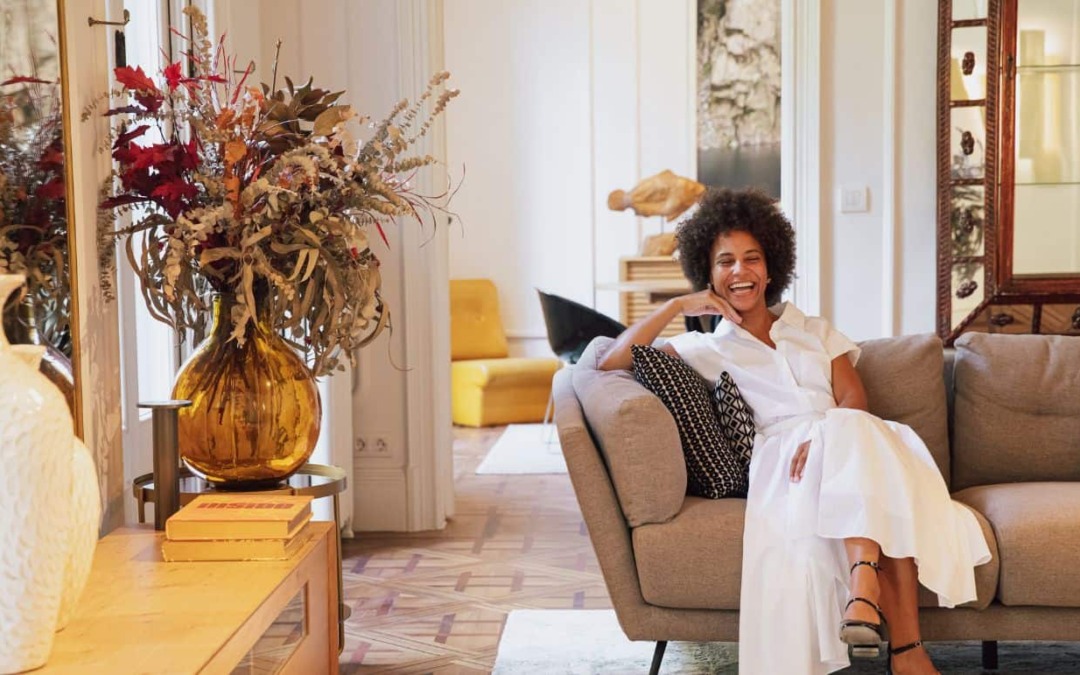
MAKEUP ARTIST MARIA PILAR

MAKEUP ARTIST MARIA PILAR

Makeup Artist

Let me introduce you to Maria Pilar, a talented makeup artist whose passion shines through her work. In a recent interview with Maria Pilar, she shared her journey into the world of makeup artistry, describing how she started and what inspires her. Maria Pilar's artistry goes beyond just makeup; she believes in creating a personalized experience for each client, making them feel comfortable and beautiful in their own skin. With a keen eye for detail and an innate sense of creativity, Maria Pilar is dedicated to helping others look and feel their best.

When did you know you wanted to be a makeup artist? 

At the age of 17. It was destiny. That was my feeling when I created makeup for the first time. At that time I had no idea about fashion and that makeup artist was going to be my profession.

Makeup Artist: Maria Pilar Photographer: Anja Zander

How long you have been a make-up artist and how did you start? 

Over more than 3 decades.
Just a little bit of my background which later had a big influence in my career. Both of my parents were musicians. My father escaped from the Hungarian Civil War in 1956 and went to Vienna to study conducting. My mother an extraordinary concert pianist from Uruguay/Rocha, came to Vienna to participate in a masterclass at the Wiener Musikakademie. There they met. Grown up with artists and friends from all over the world, visiting my parents, like composers, writers, singers, and painters were unique and very special to me.
One day, when I was 17, I was asked to help out in a designer fashion store in Vienna. Soon I began to decorate windows and mannequins with the most beautiful clothes from designers like Jean-Charles de Castelbajac, Kenzo, YSL, Dior, and Armani, just to name a few.
When the new season started, the owner of the store, invited their clients to a presentation, a small show with models.
The models did their own makeup but asked me often to help out. So I did. I had no idea about makeup, still in High school. I loved art and painting since my childhood. So I had no fear of trying. Whenever I worked in the store, my interest and passion for fashion, photography, hair, and makeup art, started to grow.
And then as it happens sometimes in life, one evening, I was dining in a trendy restaurant in Vienna, and I met Luis Burgos. He was a beautiful young man sitting next to me. We talked and I could not believe, it turned out, that he was a make-up artist from New York City, working for a few days in Vienna.
“This evening and our conversation together changed my life”. It was a turning point, it was destiny.
Luis kept contact and I became his assistant in Madrid. Assisting him was one of the most valuable experiences in my life. Luis was an extraordinary makeup artist, originally from Puerto Rico, living in New York City and Madrid.
For more than 2 years I was assisting him, it was more than I could ever ask for. He shared all his secrets and knowledge about hair and makeup art. He was incredibly generous and supportive: “always believing in me, as no one else did”.
One day, just out of the blue, he asked me to represent him for a beauty editorial for Spanish ELLE magazine.
It was like jumping into cold water... I was so nervous and excited, at that time I didn ́t know that I could do everything he taught me.

Surprisingly it went so well, that since that day I began working as a make-up artist in Madrid, Barcelona, Vienna, Milan, Paris, and Germany. It was like a dream come true.

Makeup Artist: Maria Pilar Photographer: Anja Zander

Who has inspired you throughout your career? 

My admiration for Japan began when I was working in a fashion store in Vienna. There in a magazine, I found an advertisement for Shiseido created by Serge Lutens. For me, it was the most beautiful makeup design I had ever seen. Since then I have had a deep admiration for his art, and still often look at his book “The Spirit of Beauty” today.
They are such great makeup artist in the world which inspires me, just to name a few: Luis Burgos, Serge Lutens, Tyen, Kevyn Aucion, Francois Nars, Stephane Marais, Linda Mason, Pat McGrath, Mary Greenwell, Rose-Marie Swift, Laura Mercier, Bobbi Brown, Diane Kendal,
In Germany: Yasmin Heinz, Serena Goldenbaum, Loni Baur,  I could list so many more!
Two of my best friends in Vienna studied photography. I was very lucky to spend nights in the darkroom with them and
fascinated by the process of creating a photo in the laboratory. I was able to learn a lot about photography. All of this was an additional good basis for my work as a make-up artist.

What is your favorite makeup product? 

Today there is such a large selection of makeup products. When I started as a make-up artist, there were just a few make-up companies. So we mixed everything, to create the best effect. Most of the time my hands were full of colors and possible textures to create makeup looks, and they still are today, when I test products.
For example, shimmery eyeshadow mixed with face oil ( like from Annemarie Börlind) to create a glow, lipsticks such as cream blush, and for contouring...
Favorite: foundation - Armani luminous silk, Chanel N1-Lip &Cheek Balm,Nars – The Multiple Highlighter Stick, Pat McGrath LABS Divine Skin Glow & Blur Duo, Laura Mercier Secret Camouflage, Clé de Peau Concealer, RMS Eyelights Cream Eyeshadow, Westman Atelier, Lip Suede: Les Nudes.
I try to add more and more organic vegan products into my makeup kit. There are sensational, innovative Beauty Companies in Germany, Austria, and worldwide. Ingredients, Materials, and packaging should protect our environment and give the customer an awareness of how and where a product is manufactured.
Some of my favorites: Annemarie Börlind, Dado sencs, Dr. Hauschka, Saint Charles Apothecary, und-gretel-cosmetics from Berlin, Westman Atelier, RMS.

Makeup artist: Maria Pilar OS_imagery Ochs/ Skoluda
Makeup Artist: Maria Pilar Photographer: Anja Zander

How would you describe your signature look and what is it about your styles that set you apart from other makeup artists? 

This is a difficult question.
I would say that my strength, my signature look is exposing the inner beauty of the individual, then making that beauty come forth.
Also, the whole package is important to me: my wonderful agent, teamwork, creation with the photographer, designer, creative director, stylist, model, client,... it is about inspiration, recognizing and supporting each other and being respectful to each other.
We are so different and yet a magical unity can emerge. I find that very fascinating in our work.
That's what I want for us humans, this energy of unity defies differences. In the end, what moves me is touching people with my hands through my work and giving them a precious moment, is to remind them how unique and beautiful they are.

What are the 2024 makeup trends?

It is a diversity with many influences. Everything is possible...

To know more about Maria Pilar, please visit: Kultartists


Photo Credits:
Featured image Photographer: Patrick Penkwitt
Third (with the exclusive jewelry from Wolfgang Skoluda) Photographer: by
OS_imagery Ochs/ Skoluda
Rest of the pictures: Anja Zander
THE BENEFITS OF BUYING QUALITY FASHION OVER FAST FASHION

THE BENEFITS OF BUYING QUALITY FASHION OVER FAST FASHION

Why You Should Only Buy High-Quality Clothing

One of the truest sayings in fashion is “quality over quantity.” More often than not, buying one high-quality item will always be better than buying five of the same item but made with cheaper materials.

While we all love some variety in our wardrobes, there are multiple benefits to spending your money on quality items; here are some of the best ones.

Saves Money

While, initially, high-quality items will be more expensive, they will save you a lot of money down the line. One of the biggest problems with “cheap” clothing is that the items aren’t designed to last several years.

In the time it takes to wear out a pair of Levi’s jeans or Dr Martens, for example, you would have bought two, three, or even four pairs of cheaper jeans or boots.

Looks Newer, for Longer

Because high-quality items use the best materials available, they will almost always look newer for longer. Cheap materials tend to fade, get worn down, tear, or whatever it may be, and look old quickly.

You will also tend to find that higher-quality clothing can handle being washed better than cheaper clothing, as cheaper clothing is prone to shrinking or losing its shape.

Higher Quality Clothing Feels Better

Without even looking at who made a shirt or what material it is made out of, it is very easy to tell the difference between something that is low quality and something that is high quality. Better materials feel better and more comfortable, unlike cheaper alternatives that can feel incredibly scratchy.

This applies across the board to shoes as well; soft leather will always feel more comfortable to wear compared to a cheaper, more plastic-feeling material.

Why You Should Only Buy High-Quality Clothing

Slow Fashion Helps the Environment 

One of the biggest criticisms of many affordable clothing stores over the past few years is that they contribute greatly to environmental damage. There is nothing surprising here; if you are producing something en masse, more often than not, you will be damaging the environment. 

On the other hand, high-quality garments are considered “slow fashion” as you tend to wear them longer, and there is no need to replace them after six months or a year. This means manufacturers can’t produce hundreds of tons of clothing at a time, therefore lessening their environmental impact

Better Fit

Another thing you will find with high-quality clothing is that it will fit better. Less time and effort is made with cheaper clothing to ensure it fits perfectly, as instead, you will just get the general small, medium, and large sizing. 

Cheaper clothing lacks the “nuance” required to fit different body types, and it also lacks the sizing options, too. 

Benefits of High-Quality Shoes 

As mentioned already, high-quality doesn’t just apply to clothing either, as there are several benefits to buying and wearing high-quality shoes. 

Extra Comfort

High-quality shoes tend to come with several comfort additions. This can range from a moldable insert to a more flexible material or a softer toe cap. Another factor that influences comfort is the fit of the shoe itself. 

Much like clothing, cheaper shoes tend to have very generic sizes that don’t suit every foot type. On the other hand, more expensive, better-quality shoes are able to adjust to any foot type and ensure maximum comfort. 

Better Foot Support

One of the most important things a shoe needs to do is offer foot support, and many experts will tell you that poor-quality shoes just don’t offer enough. Considering we wear shoes almost every day, for large parts of the day, you want to be certain that they aren’t damaging your feet.  

While you don’t know how well a shoe supports your foot until you have worn them for a while, higher-quality shoes tend to have better soles, inserts, and better ankle support. 

Durability 

Considering high-quality shoes can get very expensive, durability should be something that you don’t need to question. Once again, using Dr Martens as an example, they are famous for being able to handle everything from a night out to a day at a festival and almost everything in between. 

Why You Should Only Buy High-Quality Clothing

Better for Your Joint Health

One thing that many people tend to forget is that shoes aren’t just there to protect your feet. Wearing the wrong shoes, or shoes of lesser quality, will also damage far more than your feet and give you long-term problems. 

The act of walking uses your feet, ankles,  legs, knees, and hips, and all of these can be damaged over the long term by wearing poor-quality shoes. Therefore, buying the best shoes to protect your joints is essential. 

As you can see, the benefits of buying high-quality clothing, whether a dress, workout clothes, or shoes, far outweigh the cons. And yes, while they can be more expensive, as mentioned already, you will save a lot of money in the long run.

More importantly, higher-quality clothing looks better, feels better, fits better, and you can do your bit in protecting the environment too. 

AUSTRIAN COOKIES: LINZER AUGEN

AUSTRIAN COOKIES: LINZER AUGEN

Linzer Augen

In the world of traditional Austrian baking, Linzer Augen cookies stand out as a beloved classic. These delightful treats are not only visually appealing but also incredibly delicious. With a buttery dough and a sweet jam center, Linzer Augen cookies are perfect for any occasion, from holiday gatherings to afternoon tea parties. In this article, we will explore the history of these iconic cookies and provide you with an easy-to-follow recipe to recreate them at home.

Linzer Augen Cookies Recipe

The story

The History of Linzer Augen CookiesLinzer Augen cookies have a rich history that dates back to the city of Linz in Austria. The name "Linzer Augen" translates to "Linzer Eyes" in English, referring to the cookies' signature appearance of a small cutout in the center that reveals the jam filling underneath. These cookies have been a staple in Austrian bakeries for centuries, with each baker putting their own unique spin on the classic recipe.

Recipe for Linzer Augen Cookies

Now, let's dive into the recipe for making your very own batch of Linzer Augen cookies. Here is a simple and delicious recipe that will have you savoring these Austrian treats in no time.

Linzer Augen Cookies Recipe

Buttery dough, sweet jam filling
Prep Time30 minutes
Cook Time10 minutes
Course: Dessert
Cuisine: Austrian
Servings: 30 Cookies
Calories: 91kcal

Ingredients

  • 600 gr Flour
  • 400 gr Butter
  • 2 Egg yolks
  • 200 gr Caster sugar
  • 1 Pinch of lemon zest
  • 1 Pinch of salt

Instructions

  • Place the flour on the work surface and work in the chopped butter.
  • Then add the egg yolks, powdered sugar, vanilla sugar, a pinch of salt and lemon zest and quickly work into a smooth dough. Wrap the dough in cling film and leave to rest in the fridge for 1 hour
  • In the meantime, preheat the oven to 180° C, top/bottom heat
  • Now knead the dough well again, roll out to a thickness of approx. 3 mm and cut out tops with holes and bottoms without holes for the Linzer eyes. It is easier to knead and roll out the dough if you cut it in half.
  • Place the cut-out cookies on a baking tray lined with baking paper and bake for approx. 10 minutes.
  • Finally, spread the baked cookies with jam (or apply with a piping bag) and assemble one part without a hole and one part with a hole.
  • The finished Linzer eyes can be sprinkled with powdered sugar. The powdered sugar should be sprinkled on before the cookies are assembled so that the jam is still visible.

Notes

You can cut out the cookies with one or three holes as desired.
The dough is easy to roll out if you cover it with cling film.
If you are baking lots of cookies in a row, leave the baking tray to cool in between, otherwise the dough will flow apart.
The dough mixture makes approx. 30 Linzer eyes

Nutrition

Serving: 1g | Calories: 91kcal | Carbohydrates: 9g | Protein: 1g | Fat: 6g
HOW TO DECLUTTER YOUR MIND

HOW TO DECLUTTER YOUR MIND

It's all about the mind

In today's fast-paced world, our minds can easily become overwhelmed with thoughts, worries, and distractions. This mental clutter can hinder our productivity, creativity, and overall well-being. Fortunately, there are steps we can take to declutter our minds and regain our focus and clarity. In this article, we will explore effective techniques and strategies to help you declutter your mind and achieve a greater sense of peace and mental agility.

1.- Recognize and Acknowledge the Mental Clutter

The first step in decluttering your mind is to recognize and acknowledge the presence of mental clutter. Take a moment to reflect on your current state of mind. Are you constantly overwhelmed with thoughts? Do you find it difficult to concentrate on a single task? By acknowledging the existence of mental clutter, you can begin to take control of your thoughts and emotions.

2.-Identify and Release Negative Thoughts

Negative thoughts can contribute significantly to mental clutter. Identify any recurring negative thoughts or self-doubt that may be occupying your mind. Once you have identified these negative patterns, consciously make an effort to release them. Practice positive affirmations and focus on self-compassion and gratitude. By releasing negative thoughts, you create space for more positive and empowering beliefs.

3.- Practice Mindfulness and Meditation

Mindfulness and meditation are powerful tools for decluttering the mind. Allocate time each day for a mindfulness practice, whether it's through formal meditation or simply being present in the moment. Focus on your breath, observe your thoughts without judgment, and let them pass by like clouds in the sky. By practicing mindfulness, you cultivate a sense of awareness and reduce mental clutter.

4.- Prioritize and Organize

When our minds are cluttered, it can be challenging to prioritize our tasks and responsibilities effectively. Take the time to create a to-do list and prioritize your tasks based on their importance and urgency. Break down larger tasks into smaller, more manageable steps. By organizing your thoughts and tasks, you create a clear pathway for action and reduce mental overwhelm.

5.- Declutter Your Physical Space

Our external environment often reflects our internal state of mind. A cluttered physical space can contribute to mental clutter. Take the time to declutter and organize your physical surroundings. Remove any unnecessary objects, file away paperwork, and create a clean and organized space. By decluttering your physical environment, you create a sense of calm and clarity within your mind.

6.- Limit Information Overload

In today's digital age, it is easy to become overwhelmed with excessive information. Constant notifications, emails, and social media updates can contribute to mental clutter. Set boundaries for yourself and limit your exposure to excessive information. Turn off notifications, designate specific times for checking emails and social media, and create a digital detox routine. By reducing information overload, you provide space for more focused and intentional thinking.

7.- Engage in Brain Dumping

Brain dumping is a simple yet effective technique for decluttering the mind. Set aside time each day to empty your thoughts onto paper or a digital note-taking tool. Write down everything that comes to mind, whether it's tasks, worries, or ideas. By externalizing your thoughts, you free up mental space and gain a clearer perspective on your priorities.

Decluttering your mind is an ongoing practice that requires self-awareness and commitment. By implementing these strategies, you can create a mental environment that is conducive to focus, creativity, and overall well-being. Remember, decluttering your mind is not a one-time task but a continuous process of self-care and personal growth. Embrace the journey and enjoy the rewards of a clear and decluttered mind.

PAINTER ALESSANDRO DEL PERO

PAINTER ALESSANDRO DEL PERO

Alessandro del Pero Italian painter artist

Alessandro del Pero is a painter with various performances in Italy, Spain, Venezuela, Germany and Austria. Del Pero lived in Barcelona for several years, this experience and that in the USA today have allowed him to approach the best international painting of the last century. From Picasso he borrows the intuition of a psychic monstrosity, both formally and biologically. In New York, on the other hand, he discovered the painterly floods of Rothko.

In Del Pero's paintings, life surprises us from behind: "I paint to see what comes after", says the artist himself.

When and why did you decide to left your career as an architect to pursuit your career as an artist?

Painting has always been something I was holding inside, especially during my studies as an architect I had to keep it away from my duties as a student. Once I started working as an architect I also decided to test myself as a painter.

From that moment on , I knew there was no way back.

How your career as an architect influences your pieces

I don’t know if it influences my pieces , but for sure , studying as an architect trained me in visualizing 3d objects within my head. It is easy to me to think about an object and seeing it rotating in the space.

Tell us about your first exposition

My very first exhibition I remember it was in a cocktail bar in Florence. At that time I was still living there to finish my studies. I was very proud that the only sold piece was bought by a professor of the University of Architecture.

Alessandro del Pero Italian painter artist

You have traveled the world, which country had the biggest influence in your career

I have been living in different countries. As Italian I have to say that my background, my studies and my culture still have the major influence on my approach to making art.
Spain (Barcelona) is the place where I see my “transition” from architecture to painting, but the U.S.A. (New York) is where my career changed from amateur to professional.

Describe your art

I like to say I am interested in what I define as “the human aspect of things”.I am interested in the psychological aspect of the subject, and, through this exploration of the mind, i aim to create an impact on the viewer. Regardless of what the works represent, the intention is always to compose a painting that in some way gives the sense of being an entity itself, something alive.

What piece describe you the most

To be very honest, I don’t have an answer for this question. I don’t look at art as a form of self- description of the author.

Tell us about your experience in Venezuela

In 2016 I was invited by an art foundation based in New York, that creates cultural bridges between the US and Venezuela to make a show in a small museum they lead in Acarigua Araure. The museum’s program included different activities with schools.
Children were coming to see the show and were involved in many activities. It was a very good experience.

For more information please visit: Alessandro del Pero